












How Many Poker Chips Do You Start With? A Practical Guide for Home Poker Games
An open chip case looks ready for poker night until you start dividing it among the players. How many chips should each person get, and how many should stay in the bank? Even a full case can leave you short of the small denominations needed for the opening blinds.
A useful starting stack balances chip count, total value, and enough small chips to make change. Below, you’ll find cash-game and tournament examples, plus a way to turn each starting stack into a chip list for the whole table.
How many poker chips do you start with?
You can start with 45 chips per player for a $50 cash-game buy-in at $0.25/$0.50 blinds, or 35 chips per player for a 10,000-point tournament starting at 25/50 blinds. The cash amounts here are in CAD. Your chip count depends on the denominations and starting value you choose.
Your opening blinds determine which small denominations you'll need, while larger chips bring the stack up to your starting total. Equal-value stacks can contain different numbers of chips; what matters is being able to post the blinds and make change conveniently.
If you're still assigning values to unnumbered colours, our guide to poker chip values covers that step.
Two starting stacks you can count out
Either recipe gives you a starting point for your chip list. The first uses dollar values; the second uses tournament points.
A 45-chip cash-game stack
For a cash game with $0.25/$0.50 blinds and a $50 starting buy-in, this mix gives each player 45 chips:
| Denomination | Chips per player | Value in the stack |
|---|---|---|
| $0.25 | 20 | $5 |
| $1 | 20 | $20 |
| $5 | 5 | $25 |
| Total | 45 chips | $50 CAD |
The quarters let a player post the small blind with one chip and the big blind with two. The $1 chips make change easier without relying on quarters for every amount. Five $5 chips carry half the starting value. You could replace five $1 chips with one $5 chip to keep the same $50 total, but each replacement leaves fewer small chips available at that seat.
What if the starting buy-in changes to $100, with the blinds still $0.25/$0.50? Ten more $5 chips bring the original stack to that amount. Each player now has 20 quarters, 20 $1 chips, and 15 $5 chips: 55 chips worth $100 CAD.
With the blinds unchanged, you can keep the same quarters and $1 chips and add $5 chips to reach the higher buy-in. If the blinds change too, the smallest denomination may need to change before you adjust the rest.
For eight players, this revised stack needs 120 $5 chips, so the 100 included in the $50-game configuration below would no longer cover the starting stacks.
A 35-chip tournament stack
This home poker tournament example has 25/50-point opening blinds with no ante, with each player starting with 10,000 points in 35 chips:
| Denomination | Chips per player | Points in the stack |
|---|---|---|
| 25 | 12 | 300 |
| 100 | 12 | 1,200 |
| 500 | 5 | 2,500 |
| 1,000 | 6 | 6,000 |
| Total | 35 chips | 10,000 points |
These are tournament points, not a $10,000 cash value.
At the opening level, one 25-point chip covers the small blind and two cover the big blind. This mix works with a blind schedule whose amounts are multiples of 25 points; a schedule starting at 10/20 would need a smaller denomination. The 500s and 1,000s keep the 10,000-point stack manageable while the 25s and 100s provide change for the early levels.
Equal values can be built from different combinations, but giving everyone the same starting mix makes preparation and checking simpler.
Count the whole table and leave a bank
Multiplying the chips per player by your player count gives you the number needed for the starting stacks. Counting each denomination separately shows whether your case has the right mix.
The bank is the separate supply you keep back for change and any additional chip needs you've planned.
For eight players, the cash-game recipe needs 160 $0.25 chips, 160 $1 chips, and 40 $5 chips. That's 360 pieces representing eight $50 buy-ins, or $400 CAD.
Eight tournament stacks need 96 chips marked 25, 96 marked 100, 40 marked 500, and 48 marked 1,000. That's 280 pieces representing 80,000 points.
A case can have enough chips in total and still run short of a denomination. For example, 500 chips containing only 100 quarters cannot provide the 160 required by the eight-player cash-game recipe.
The bank has three separate jobs:
-
Making change. Making change exchanges equal values; it doesn't add to a player's total.
If all your quarters are in players' stacks, a bank full of $5 chips can't break a $1 chip into four quarters.
Having some of the opening denominations left in the bank makes that change possible, even when the total chip count looks generous.
-
Providing extra starting stacks. If your rules allow late entries or rebuys, the number of extra stacks you plan to offer affects what you'll need in the bank.
Two extra stacks using the tournament recipe need 24 chips marked 25, 24 marked 100, 10 marked 500, and 12 marked 1,000: 70 chips in all.
Set those extra stacks aside before counting what’s available for change.
-
Replacing small tournament chips later. Your blind schedule also tells you which denominations you'll need later. When the remaining blinds and any antes no longer need 25-point increments, larger chips can take over that value.
Four 25s equal one 100, and five 100s equal one 500.
Those exchanges need suitable larger denominations in the bank, plus enough smaller chips to represent the amounts still in use. More spare 25s won't solve a shortage of larger replacement chips.
Bicycle's Basics of Poker recommends writing down your house rules. Including your chip values and any late-entry or rebuy rules helps you prepare the bank for the game everyone expects.
Build the set around your chip list
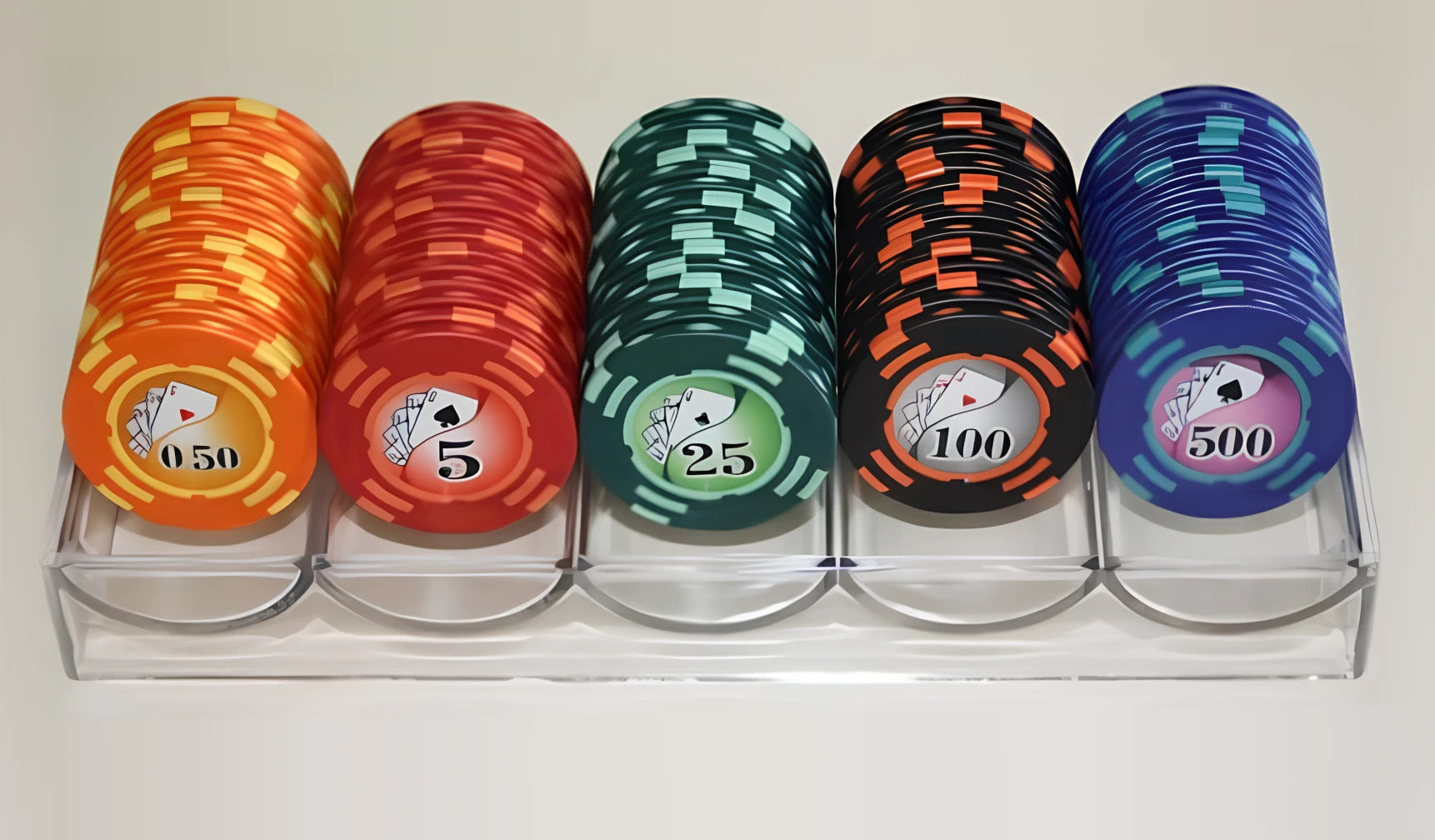
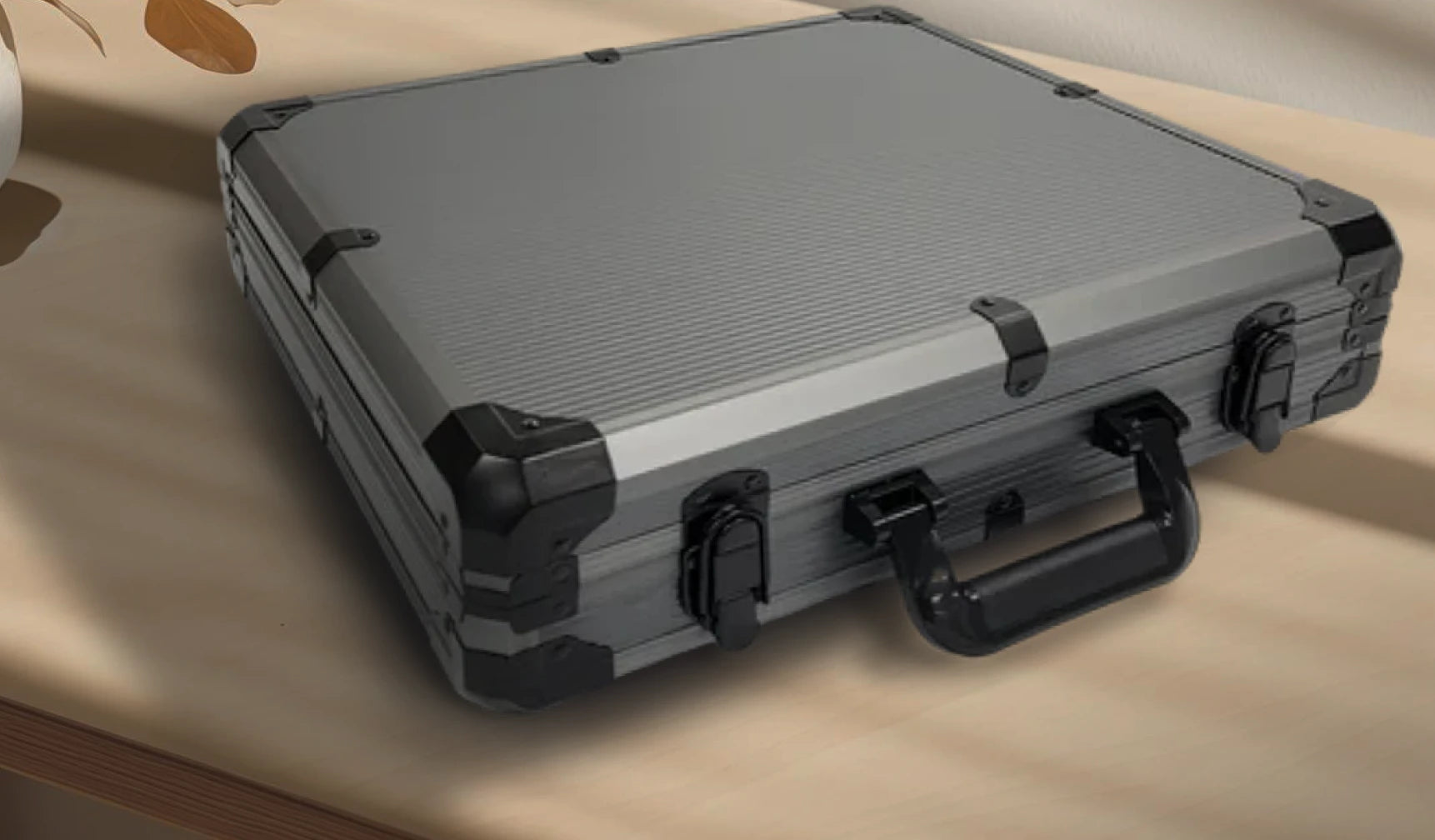
If you're putting together a full supply, the 500PCS 14g Monte Carlo Poker Club Poker Chips Set with Silver Aluminum Case lets you adjust the quantities of each denomination. You can match the set to your planned starting stacks and bank.

For the eight-player $50 cash-game example, one adjustable 500-chip mix is 200 quarters, 200 $1 chips and 100 $5 chips. After issuing the starting stacks, you'd have 40 quarters, 40 $1 chips and 60 $5 chips in the bank. That gives you small change and larger-value pieces, though any planned extra stacks come out of those quantities before you know how much is left for change.
For the tournament example, the eight starting stacks use 280 chips, leaving 220 chips for the bank. If you prepare the two extra stacks described above, 150 pieces remain for change and later exchanges. With no extra entries, you can direct more of that reserve towards the larger denominations your later levels need.
If your poker nights switch between cash games and tournaments, a denomination list for each format helps you choose the mix. A 500-chip set may have enough pieces for either game, but you’ll still need the right mix of denominations.
Short of one denomination?
For the eight-player cash-game stacks, owning 125 quarters against a need for 160 leaves you 35 chips short.
Monte Carlo Poker Club Poker Chip Rolls contain 25 chips per roll. In this case, two rolls in the $0.25 denomination cover the shortage, leaving 15 spare chips.

Ready for the first hand
Counting out one complete starting stack lets you check that it can pay your opening blinds before you make up the rest. Once every player has the same mix, a final look at the bank will show whether you've covered change, any additional stacks and the later exchanges you've planned.
Once you know which denominations you need, explore MRC Poker’s Monte Carlo Poker Club sets and matching refill rolls to put your setup together.


